
Cutterhead Disc Layout: What Improves Rock Breaking Efficiency?

Cutterhead Disc Layout: What Improves Rock Breaking Efficiency?
Why does one cutterhead perform smoothly in hard rock while another stalls, wears fast, or wastes thrust?
The answer often starts with cutterhead disc layout.
For field performance, layout is not just a drawing detail.
It controls how force enters the rock, how cracks connect, and how evenly cutters share the load.
That directly shapes penetration rate, vibration, torque demand, and cutter life.
In practical tunneling, a strong cutterhead disc layout helps keep excavation stable across changing geology.
It also helps teams reduce unplanned stops, limit abnormal wear, and use available thrust more effectively.
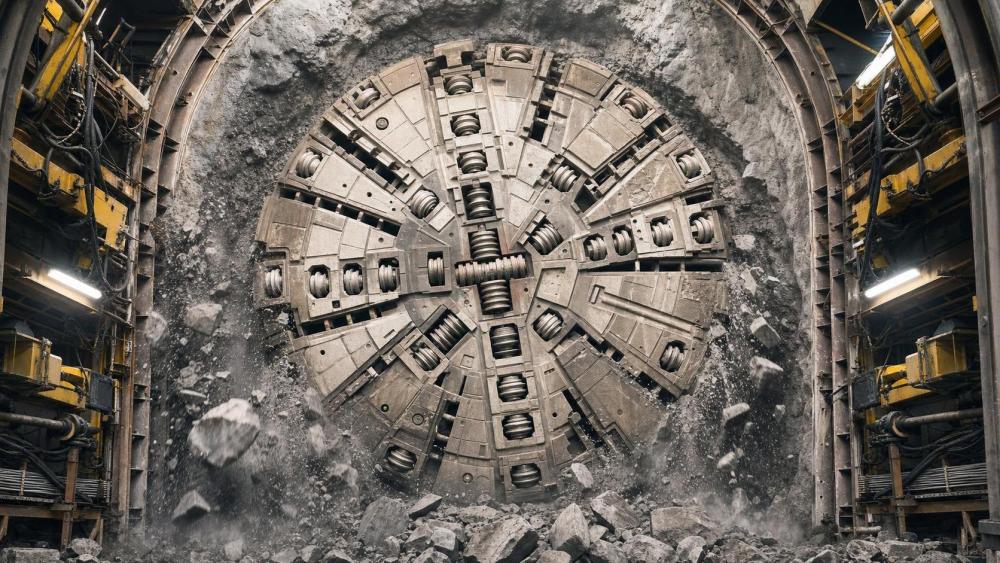
That is why cutterhead disc layout remains a core topic across TBM design, shield optimization, and rock excavation analysis on UTES.
The goal is simple: break more rock with less wasted energy.
Why cutterhead disc layout matters so much
A disc cutter does not remove rock like a cutting knife.
It presses into the face, creates crushed zones, and drives cracks outward.
When adjacent cutters are positioned well, these cracks intersect and release chips efficiently.
When spacing is wrong, the machine spends energy crushing the same zone repeatedly.
That usually means lower advance rate and higher wear.
A good cutterhead disc layout balances three things at the same time.
- Sufficient spacing for crack interaction.
- Proper load distribution across the cutterhead.
- Stable rolling contact through the full excavation face.
This is where efficiency gains usually appear first.
The machine does not need more force only.
It needs force applied in the right pattern.
Key layout factors that improve rock breaking efficiency
1. Disc spacing and crack interaction
Disc spacing is the most discussed part of cutterhead disc layout for a reason.
If cutters sit too close, the crushed zones overlap too much.
Energy is wasted, heat rises, and ring wear accelerates.
If cutters sit too far apart, cracks fail to join.
The result is poor chip formation and slower penetration.
The best spacing depends on rock strength, brittleness, jointing, and cutter diameter.
From a field perspective, abnormal fines generation often signals ineffective spacing.
2. Center, inner, and gauge cutter positioning
Not every cutter works under the same conditions.
Center cutters see different rolling paths than gauge cutters.
Inner cutters usually carry a heavy share of bulk rock breaking.
Gauge cutters protect profile accuracy and sidewall shaping.
A strong cutterhead disc layout adjusts spacing and attack path by radial zone.
Uniform placement rarely delivers uniform performance.
3. Load distribution across the face
Uneven load is one of the fastest ways to lose efficiency.
Some cutters overwork, while others contribute too little.
That creates vibration, local overheating, and irregular wear patterns.
A better cutterhead disc layout spreads thrust and contact stress more evenly.
This improves rolling stability and supports smoother torque behavior.
4. Cutter path overlap and coverage
Each disc follows a circular path during rotation.
These paths must cover the face without creating dead zones.
Poor overlap leaves ridges or unbroken zones between passes.
Excessive overlap wastes energy and increases rolling resistance.
Efficient cutterhead disc layout aims for complete but economical face coverage.
How geology changes the best cutterhead disc layout
No layout works equally well in every formation.
This is where many efficiency assumptions break down.
Hard, massive rock often benefits from spacing that encourages strong crack coalescence.
Highly fractured ground may need a more controlled arrangement.
Otherwise, cutters can bounce, slip, or experience unstable contact.
Mixed ground adds another complication.
Part of the face may break easily, while another zone resists strongly.
In these cases, cutterhead disc layout must support more balanced load transfer.
That helps limit shock loading on individual cutters and bearings.
A practical review should consider:
- UCS and abrasivity of the rock.
- Joint frequency and bedding orientation.
- Water inflow and face instability risks.
- Expected fines versus chip generation.
- Machine thrust and torque limits.
This also explains why layout decisions belong to both design and operations teams.
Common signs that the cutterhead disc layout is underperforming
Underperformance is usually visible before it becomes a major failure.
The signals are often operational, not theoretical.
When these patterns appear together, the cutterhead disc layout deserves a closer review.
Waiting too long usually turns an efficiency issue into a maintenance issue.
Practical ways to evaluate and improve cutterhead disc layout
In actual projects, layout improvement should be evidence-based.
Small changes in arrangement can produce large changes in cutter consumption.
- Compare penetration rate against thrust and torque, not as an isolated number.
- Map cutter wear by radial position to identify overloaded zones.
- Review muck size distribution for signs of efficient chipping.
- Track vibration events against geological changes and cutter positions.
- Check whether gauge and inner cutters are wearing in a balanced pattern.
This approach helps separate layout problems from hydraulic, thrust, or operational setting problems.
It also supports smarter communication between site teams, OEMs, and procurement units.
From a procurement angle, asking about cutterhead disc layout should be standard practice.
The key questions are straightforward.
- How is the layout adapted for expected geology?
- What spacing logic is used by radial zone?
- How does the supplier validate load distribution?
- Which project cases show similar rock conditions?
These questions lead to better decisions than simply comparing cutter counts.
A smarter view of efficiency
Rock breaking efficiency is never about one variable alone.
Still, cutterhead disc layout often decides whether available machine power becomes productive excavation.
A well-planned cutterhead disc layout improves chip formation, balances cutter loads, and reduces wasted crushing energy.
It also supports steadier advance, lower wear, and fewer costly interventions.
For teams working with TBMs, shield machines, and underground excavation systems, that makes layout a practical performance lever.
On UTES, this topic connects directly with cutter wear analysis, geology adaptation, and excavation cost control.
If efficiency is dropping, start by looking at the cutterhead disc layout.
That is often where better rock breaking begins.
Rleated News
Industry Briefing
Get the top 5 industry headlines delivered to your inbox every morning.